When business owners ask, “How much does a professional website cost in the U.S.?” they are usually expecting a number.
But the real answer is not a number.
It is a framework.
Because in 2026, a website is no longer a digital brochure. It is infrastructure. It is sales architecture. It is automation. It is data collection. It is brand positioning. It is security. It is performance engineering. And increasingly, it is the first point of trust between a company and its market.
The price depends entirely on whether you are building something temporary or something that compounds in value.
Let’s unpack this properly.
The Market Has Changed… Dramatically
Five years ago, a “good website” meant something visually modern and responsive.
In 2026, expectations are radically different.
Google measures performance at a technical level through Core Web Vitals. Consumers expect instant load times. Data privacy regulations are stricter. Cybersecurity threats are more sophisticated. AI tools have raised the baseline for design quality. And advertising costs are higher, which means conversion optimization matters more than ever.
At the same time, AI website generators can now produce a polished-looking site in under five minutes.
This creates confusion.
If AI can build a site for $30 per month, why are agencies charging $15,000?
Because they are not building the same thing.
The difference is not aesthetic.
It is structural.
The AI Website Illusion
AI website builders are impressive. They generate layouts, The AI Website Illusion
Let’s start with honesty.
AI website builders in 2026 are genuinely impressive.
You answer a few questions, describe your business, click a button and within minutes you have a polished website. Layouts are clean. Sections are organized. Navigation makes sense. There’s even placeholder copy that sounds surprisingly professional.
For early-stage founders validating an idea, launching a side project, or needing a temporary online presence, this is wonderful. It lowers the barrier to entry. It removes friction. It makes publishing accessible.
But here’s where the illusion begins.
A site that looks complete is not the same as a site that is structurally complete.
AI-generated websites operate inside shared ecosystems. They rely on standardized backend logic. They use common templates, common design systems, common performance configurations. They run on shared hosting environments where thousands sometimes millions — of other websites exist under the same infrastructure.
Their security layers are generalized. Not personalized. Not engineered around your specific business model.
And this matters more than most people realize.
When thousands of websites share similar structures, vulnerabilities become scalable. If there is a weakness in a plugin, a template layer, or a backend component, attackers don’t need to target your business specifically. They target the pattern.
Predictable systems are easier to test. Easier to probe. Easier to automate attacks against.
It’s not that AI builders are “bad.” It’s that they are designed for mass efficiency — not for strategic differentiation or hardened architecture.
Then there’s performance.
On AI platforms, you don’t control server configuration. You don’t control deep caching layers. You don’t optimize backend queries. You don’t define how assets are served globally. You operate within preset constraints.
That works — until it doesn’t.
Until traffic spikes.
Until you start running paid ads.
Until your SEO begins to rank nationally.
Until users expect instant load times.
At that point, platform limitations become invisible ceilings.
AI tools optimize for speed of deployment, not architectural resilience. They are built to get you online quickly — not to future-proof your infrastructure.
They don’t stop and ask the uncomfortable but critical questions:
- How will this site scale in three years if revenue doubles?
- How will it integrate cleanly with a CRM, marketing automation, or custom dashboards?
- What happens when 5,000 visitors land on the site in one day?
- How is user authentication handled if we add secure areas or client portals?
- How do we structure content for long-term SEO dominance instead of short-term indexing?
- How do we reduce operational friction inside the business?
AI builds what users see.
Professional teams build what businesses depend on.
That’s the cost difference.
At Neural Nexus, we embrace AI as a tool but not as an architect. We use it to accelerate research, refine workflows, and enhance efficiency. But the system itself? That’s engineered intentionally.
- We start with business objectives.
- We map growth scenarios.
- We design scalable architecture.
- We build secure backend logic.
- We integrate CRM and automation layers properly.
- We structure content for long-term search performance.
- We optimize performance beyond default platform limits.
Because a serious business doesn’t just need a website that looks good on launch day.
It needs infrastructure that still performs three, five, even seven years from now.
AI builds surfaces.
We build systems that compound.
And that difference is exactly why professional websites cost more and why, for growth-focused businesses, they’re worth it.
The True Cost Ranges in 2026
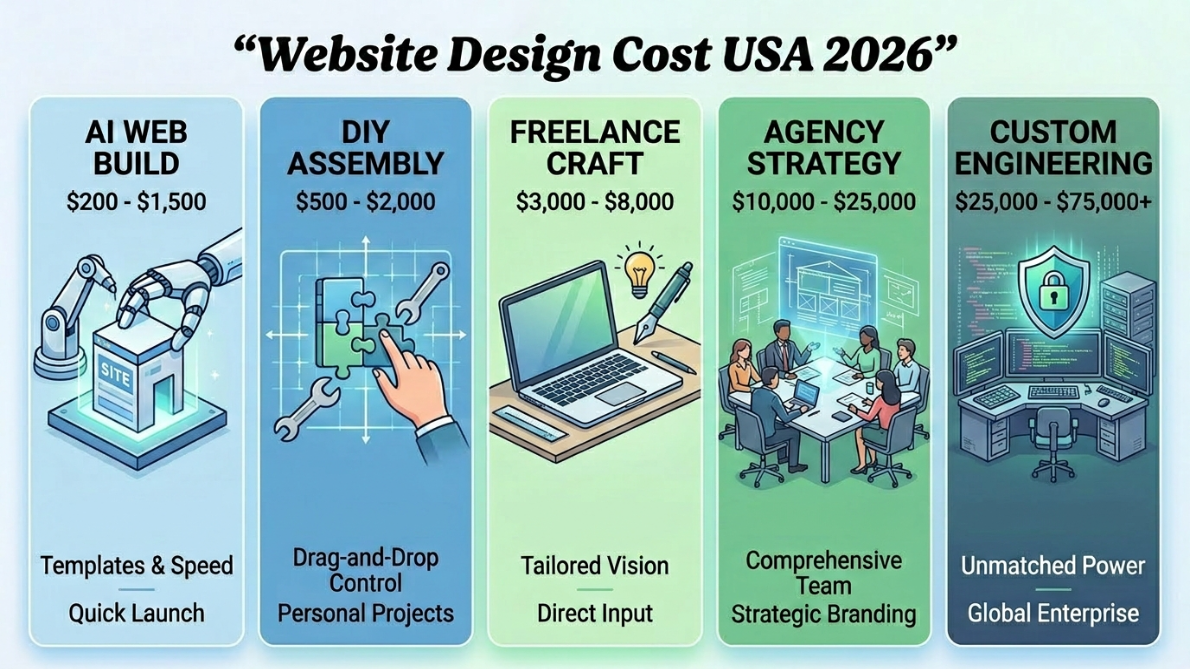
For U.S. businesses in 2026, pricing typically falls into distinct categories.
At the bottom end, DIY and AI platforms cost under $2,000 annually. These are suitable for micro-businesses or validation phases.
Freelancer-built template websites usually range between $3,000 and $8,000. These provide basic customization but often rely heavily on themes and plugins. They can work well for small local companies, but they often require rebuilding within a few years due to technical debt.
Professional agency builds typically begin around $5,000 and can extend to $30,000. At this level, strategy, UX planning, SEO structure, and performance optimization begin to matter.
High-end custom development ranges from $15,000 to $75,000 or more. This is where architecture, backend logic, automation systems, and security hardening become central components.
Enterprise-level platforms exceed $100,000 and can reach several hundred thousand depending on complexity.
The critical insight is this:
You are not paying for pages.
You are paying for decisions.
Why Security Alone Can Justify Higher Pricing
In 2026, cybersecurity is not optional.
Low-cost builds frequently rely on plugin ecosystems with varying levels of maintenance. Many WordPress-based sites, for example, depend on third-party components that introduce vulnerabilities over time.
Common risks include:
- SQL injection attacks
- Cross-site scripting (XSS)
- Weak authentication systems
- Inadequate rate limiting
- Exposed API endpoints
- Improper server configurations
When a breach happens, the cost is not just technical repair. It is reputational damage.
For businesses collecting payment data, medical information, financial data, or customer records, the cost of insecurity far exceeds the difference between a $5,000 and $30,000 website.
Professional infrastructure involves:
- Hardened server environments
- Proper API validation layers
- Secure authentication architecture
- Data encryption standards
- Backup and monitoring systems
- Structured deployment processes
This is not visible in the design.
But it is embedded in the price.
Conversion Architecture: The Hidden Multiplier
Another factor most business owners underestimate is conversion engineering.
A cheap website may look clean and modern. But it often lacks intentional flow.
- Where does the user land?
- What is the psychological trigger?
- Where is the trust reinforcement?
- When is the call-to-action introduced?
- Is friction minimized?
- Is form behavior optimized?
- Is load speed affecting abandonment?
These are not design questions.
They are behavioral economics questions.
A professional website in 2026 is built backwards from revenue.
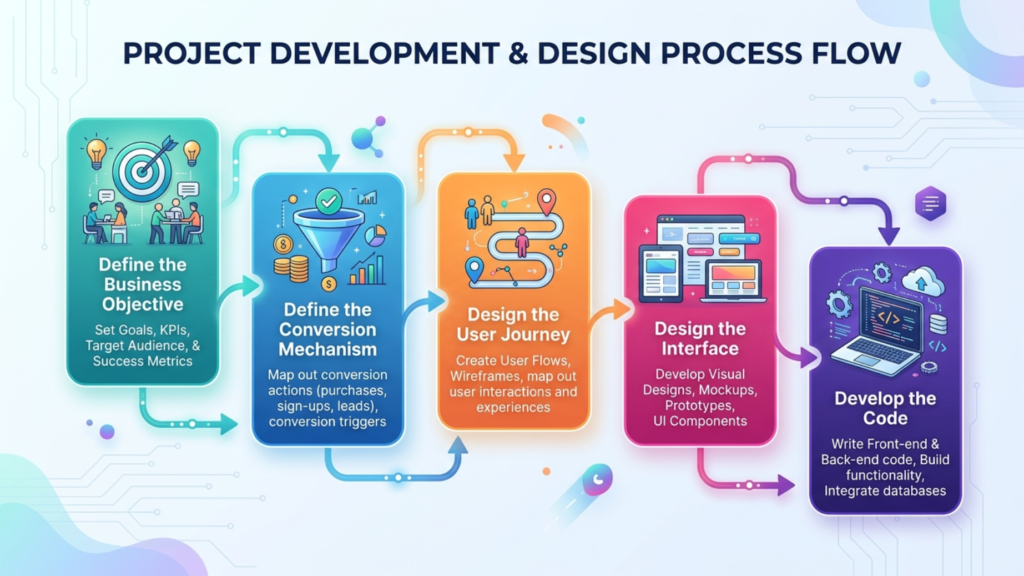
Reversing this order — starting with visuals — is the most common mistake in low-cost builds.
Why Cheap Websites Often Cost More Over Five Years
Let’s consider a typical scenario.
A company invests $5,000 in a template-based site.
It performs adequately but not exceptionally. After two years, traffic grows. Performance issues appear. Plugin conflicts increase. Security warnings occur. SEO scalability becomes limited.
Now they need a rebuild.
The rebuild costs $15,000.
Total five-year cost: $20,000.
But they lost two years of optimized growth.
Compare that to investing $20,000 initially in scalable architecture designed for long-term growth.
The difference is not price.
The difference is compounding.
What Drives Custom Website Development Cost
Custom website development cost is influenced by several core factors.
- Complexity of functionality. A static informational site differs dramatically from a site integrating CRM systems, automation flows, user dashboards, or payment logic.
- Performance requirements. High-performance frontend frameworks like React or Next.js require specialized development expertise but enable superior scalability and speed.
- SEO architecture. Building structured, scalable keyword ecosystems requires planning at the content and code level.
- Security and compliance standards. Industries like healthcare or finance demand stricter protocols.
- Design depth. High-end interactive experiences with animation systems, advanced transitions, and dynamic elements require additional engineering time.
When you understand these drivers, the price range becomes rational rather than arbitrary.
Why Prices Are Higher in 2026
If you’ve looked at website pricing recently and thought, “Why is this so much more expensive than a few years ago?” — you’re not imagining it.
Professional web design pricing in the United States has increased. But not randomly. Not because agencies decided to charge more. And not because design suddenly became harder.
Prices went up because expectations, risks, and business complexity went up.
Let’s break down why.
1. Advertising Is More Expensive — So Conversion Matters More
In 2026, paid traffic is not cheap.
Whether you’re running Google Ads, Meta campaigns, TikTok ads, or local service ads, cost-per-click is higher than it was five years ago. In competitive industries, clicks can range from $5 to $50+ depending on niche and geography.
That changes the equation.
If traffic is expensive, your website can’t just look good. It has to convert efficiently.
That requires:
- Intent-based page structure
- Psychological flow in layout
- Strategic placement of trust signals
- Reduced friction in forms
- Optimized loading speed
- Clear CTA hierarchy
- Structured lead funnels
A template site doesn’t consider your ad economics.
A professional build does.
At Neural Nexus, we design websites backwards from revenue goals. If you’re spending on traffic, your site must perform like a conversion engine — not a digital brochure. That level of thinking requires more planning, more testing, and more engineering.
And that impacts cost.
2. Security Threats Are More Sophisticated
Cybersecurity in 2026 is not optional.
Automated bot attacks, credential stuffing, API exploitation, scraping attacks — these are everyday realities now. Even small businesses are targets because attacks are automated at scale.
Five years ago, basic SSL and a plugin firewall were often considered “enough.”
Today, that’s baseline — not protection.
Professional websites now require:
- Hardened server environments
- Secure API endpoints
- Authentication flow control
- Rate limiting
- Proper role-based access systems
- Clean dependency management
- Secure environment variable handling
- Monitoring and backup architecture
Security is invisible work. But it’s highly technical.
Cheap builds skip this depth.
At Neural Nexus, we design with a security-first mindset — especially for businesses collecting customer data, running payments, or integrating CRMs. We engineer infrastructure that reduces risk, not just surfaces that look secure.
That added resilience is part of modern pricing.
3. Performance Expectations Are Stricter
Users expect instant load times.
Google enforces Core Web Vitals.
Search rankings are influenced by performance metrics.
If your site loads slowly, users leave. If users leave, conversions drop. If conversions drop, ad costs increase.
Performance optimization is no longer optional polish — it is strategic.
That means:
- Optimized frontend frameworks
- Clean code structure
- Proper image handling
- Caching strategies
- CDN implementation
- Query optimization
- Minimal technical debt
AI builders and cheap templates often operate inside preset performance ceilings. You don’t control deeper optimization layers.
At Neural Nexus, we build with performance in mind from day one — not as an afterthought. That’s why our sites scale better under traffic and maintain speed even as complexity increases.
Performance engineering requires expertise. Expertise costs more than drag-and-drop assembly.
4. AI Raised the Visual Standard
Here’s something ironic.
AI actually made professional design more valuable.
Why?
Because now anyone can generate a decent-looking layout in minutes. That means “clean and modern” is no longer a differentiator.
To stand out, businesses now need:
- Strong brand positioning
- Strategic UX
- Custom interaction systems
- Deeper storytelling
- Thoughtful hierarchy
- Differentiated structure
Surface-level polish is no longer impressive.
Real differentiation requires intentional design thinking.
At Neural Nexus, we don’t compete on “looks good.” We compete on strategic clarity and architectural depth. That’s how businesses separate themselves from the sea of AI-generated sameness.
5. Websites Are No Longer Isolated Projects
In 2026, your website is not a standalone digital asset.
It connects to:
- CRM systems
- Email automation
- Analytics platforms
- Marketing automation tools
- Payment processors
- Scheduling systems
- Internal dashboards
- Advertising platforms
It is the operational hub of your digital ecosystem.
That integration complexity increases development requirements.
Connecting systems properly — securely and efficiently — requires planning, backend logic, API configuration, testing, and long-term maintenance thinking.
This isn’t “design work.”
It’s infrastructure work.
And infrastructure requires engineering.
So Why Is Neural Nexus a Strong Solution in This Environment?
Here’s the part most U.S. business owners don’t realize:
Compared to major U.S. agencies charging $20,000–$80,000 for similar infrastructure, Neural Nexus is actually extremely competitive often significantly more cost-efficient — while delivering equivalent architectural depth.
We combine:
- Strategic planning
- Modern frontend engineering
- Secure backend architecture
- Conversion-focused UX
- SEO-ready structure
- Automation integration
- Long-term scalability
But without the inflated overhead of large American agencies.
We are not the cheapest option on the market and we shouldn’t be.
Serious infrastructure is never built at the lowest possible price. But for the level of architectural depth, performance optimization, security layering, and automation integration we deliver, Neural Nexus remains highly competitive within the U.S. market.
You’re not paying for corporate office overhead, inflated agency hierarchies, or bloated account-management layers.
You’re investing in focused engineering.
We operate lean, strategic, and systems-first. That allows us to deliver infrastructure-level builds without the $40,000–$100,000 price tags often seen at large U.S. agencies.
And we don’t just build websites in isolation.
We think in systems.
From automation workflows to intelligent digital ecosystems, we actively explore and implement tools that increase operational leverage — including AI frameworks that genuinely improve business performance. If you’re interested in how modern AI tools can enhance productivity and revenue beyond just website design, we’ve broken that down in detail in our guide to the Top 8 Best AI Agents That Actually Improve Income or Productivity.
Because ultimately, a website shouldn’t exist alone.
It should connect, automate, optimize, and compound.
That’s what focused engineering delivers.
Leave a Reply